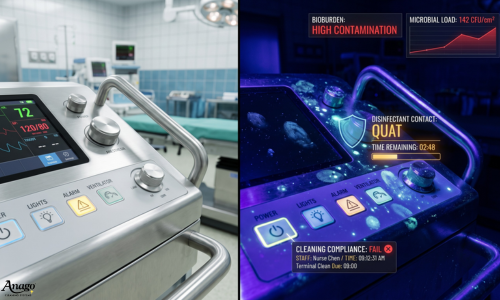
Medical facilities must transition from manual, checklist-based sanitation to data-driven cleaning programs to satisfy CDC standards and Joint Commission audits. By integrating quality assurance systems, cloud-based portals, and automated tracking, healthcare facility managers transform subjective cleaning tasks into verifiable, audit-ready compliance streams. When clean is non-negotiable, leveraging technical commercial cleaning KPIs mitigates cross-contamination risks and protects facility assets.
How can technology-enabled commercial cleaning systems guarantee audit readiness?
Cloud-based communication portals and automated quality assurance apps turn qualitative sanitation performance into verifiable, transparent data streams that pass strict regulatory audits.
Traditional healthcare cleaning relies on manual paper logs and visual inspections, both of which fail to provide verifiable evidence during regulatory reviews. Modern compliance frameworks demand digital, timestamped validation. Technology-enabled cleaning management replaces subjective evaluation with objective surface metrics, ensuring facilities meet every regulation without missing a beat.
For decades, medical environments relied on visual cleanliness as the primary metric for facility readiness. However, visual inspections fail to detect bioburden, viral loads, or improper chemical application. The transition toward stringent regulatory frameworks enforced by agencies like the Centers for Disease Control and Prevention (CDC) and The Joint Commission (TJC) requires facility managers to produce defensible, objective proof of sanitation.
Many healthcare operations leaders assume that high Adenosine Triphosphate (ATP) bioluminescence pass rates or spotless visual inspections guarantee audit success. This is a dangerous misconception.
Modern regulatory surveyors utilize “tracer methodology” to evaluate operational repeatability and process adherence. An isolated surface swab proves that a countertop was clean at a single moment in time; it does not prove that an operating suite was sanitized using correct contact times or EPA-registered disinfectants throughout an entire operational cycle. Visual cleanliness without automated, timestamped validation logs offers zero legal or regulatory protection during an infection outbreak investigation or an unannounced inspection.
Facility service partners must look beyond superficial appearances. By shifting focus from subjective outcomes to technical process metrics, healthcare organizations eliminate operational blind spots, mitigate risk, and maintain permanent audit readiness.
Healthcare facilities must track specific facility cleaning metrics to verify bioburden reduction and risk mitigation. Essential KPIs include ATP pass rates, dwell-time compliance for EPA-registered disinfectants, corrective action resolution speeds, and high-touch surface execution accuracy. Tracking these metrics standardizes decontamination protocols across clinical environments.
Establishing robust quality assurance systems requires tracking both outcome-based and process-based metrics. The following table outlines the technical metrics required to align janitorial operations with strict regulatory standards:
| Metric / KPI | Technical Definition | Target Benchmark | Regulatory / Entity Alignment | Operational Impact | |
| Dwell-Time Adherence Rate | Percentage of surface applications meeting required disinfectant wet contact time. | ≥ 98.5% | EPA-registered Disinfectants / CDC Standards | Mitigates pathogen survival; prevents chemical under-dosing. | |
| Corrective Action Resolution Time | Elapsed time from a flagged QA portal deficit to verified remediation. | < 2 Hours (Critical Clinical Zones) | OSHA Standards / Infection Control | Accelerates risk containment prior to patient admission. | |
| High-Touch Execution Index (HTEI) | Percentage of designated clinical touchpoints verified via QA applications. | ≥ 99.0% | CDC / Joint Commission Standards | Standardizes decontamination across shifts and personnel. | |
| Airborne Particulate & Exhaust Audit Score | Differential pressure and particulate validation post-terminal clean. | Zero Deviation from baseline | HEPA / ASHRAE 170 Standards | Mitigates airborne pathogen transmission in isolation suites. | |
| SLIP-Resistance / SCOF Compliance | Static Coefficient of Friction measurement on hard surface flooring. | ≥ 0.60 SCOF | SCOF Standards / OSHA Safety | Reduces slip-and-fall liabilities in high-traffic corridors. | |
When facility leaders establish these specific indicators, data-driven cleaning programs transition from reactive overhead into measurable risk management assets.
Automated quality assurance applications use real-time GPS verification, digital inspection forms, and automated reporting to track janitorial workflows. When integrated with cloud portals, these systems capture instant data from sanitation technicians, transforming qualitative tasks into transparent, timestamped audit records that prove compliance instantly.
Transitioning from qualitative tasks to quantifiable metrics requires an integrated clean-tech architecture. The deployment of a modern quality assurance system follows four distinct operational phases:
Across healthcare networks utilizing real-time digital inspection forms, facilities experienced a 42% reduction in repeat sanitation deficiencies within 90 days of implementation.
Securing executive buy-in for data-driven janitorial technology requires tailoring the business case to specific stakeholder priorities. Framing tech-enabled cleaning management as a strategic risk-mitigation tool aligns operational goals with financial, legal, and clinical requirements, accelerating internal approval across complex buying committees.
| Leadership Role | Core Priority | Key Messaging Angle |
| Chief Medical Officer (CMO) | Clinical Risk & Infection Rates | Focus on clinical risk reduction. Explain how automated dwell-time tracking and standardized CDC-aligned workflows directly reduce Healthcare-Associated Infections (HAIs), protecting patient outcomes. |
| Chief Financial Officer (CFO) | ROI & Penalty Avoidance | Frame the investment around risk avoidance. Highlight how technology-enabled cleaning management mitigates CMS Hospital-Acquired Condition (HAC) financial penalties and optimizes labor allocation. |
| EH&S & Compliance Officers | Audit Defense & Regulatory Safety | Emphasize audit readiness. Demonstrate how instant cloud reporting guarantees professional cleaning that passes inspection every time, delivering immutable proof for OSHA and Joint Commission evaluations. |
| Director of Facility Operations | Operational Control & Efficiency | Position the system as an operational force multiplier that standardizes service accountability, eliminates administrative overhead, and simplifies vendor management across complex physical footprints. |
Mitigating contamination risks and satisfying complex healthcare regulations requires more than traditional janitorial routines. It demands an enterprise-grade facility commercial cleaning service partner. Reach out for a technical evaluation of your operational readiness today!
By Darlene Bernd, Content Marketing Manager