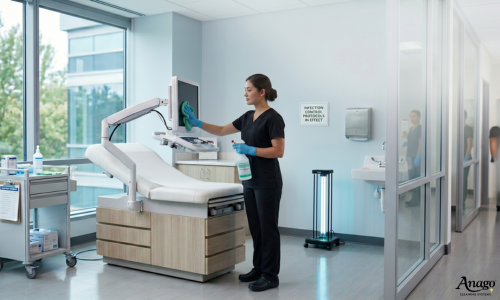
Healthcare-grade cleaning and disinfection services mitigate clinical risk by standardizing infection control protocols that exceed basic janitorial standards. By utilizing EPA-registered disinfectants and adhering to CDC and OSHA bloodborne pathogen standards, specialized commercial cleaning facility service partners protect patient safety, preserve high-value medical assets, and safeguard a facility’s reputation against liability and healthcare-associated infection (HAI) financial losses.
In a clinical environment, “cleaning” isn’t simply a maintenance task. It’s a critical defensive strategy. Standard janitorial services focus on aesthetic cleanliness (vacuuming and trash removal), which fails to address the microscopic bioburden present in high-touch medical environments.
Professional medical office cleaning utilizes a tiered approach to disinfection that targets pathogens at the molecular level, effectively reducing the transmission of Healthcare-Associated Infections (HAIs).
The stakes for facility managers have never been higher. According to recent analysis from the Agency for Healthcare Research and Quality (AHRQ), the annual cost of HAIs in the U.S. is projected to exceed $35 billion by 2025. Under current value-based care models, a significant portion of these costs is non-reimbursable.
Partnering with a specialized service ensures your facility remains compliant with Joint Commission and CDC standards, effectively shifting the burden of liability from the facility manager to a standardized, audited protocol. Whether you manage 1,000 or 1,000,000 square feet, the risk is not just biological – it’s financial.
Many facility managers mistakenly equate a strong scent of bleach or floral fragrance with a sterile environment. In reality, heavy scents often mask poor Indoor Air Quality (IAQ) and can signal a lack of proper HEPA-filtered air exchange.
Industry Correction: A truly disinfected medical environment should be odorless. Excessive chemical odors often indicate high levels of Volatile Organic Compounds (VOCs), which can irritate respiratory-compromised patients and degrade sensitive diagnostic equipment. Modern infection prevention focuses on high-efficacy, low-toxicity chemicals that neutralize pathogens without compromising the air that patients and staff breathe.
Whether managing a boutique dental clinic or a massive hospital campus, asset preservation is a core ROI driver. High-value medical equipment and specialized flooring represent significant capital expenditures that must be protected from improper maintenance.
| Asset Type | Standard Cleaning Risk | Facility Partner Mitigation Strategy | ROI Impact (5-Year Projection) |
| Diagnostic Imaging (MRI/X-Ray) | Dust accumulation leading to overheating. | HEPA-filtered vacuuming and static-neutral microfibers. | 15% Reduction in unscheduled downtime. |
| Medical-Grade Flooring | Chemical stripping causing porous degradation. | pH-neutral, manufacturer-approved cleaning agents. | 3-year extension of floor lifecycle. |
| High-Touch Surfaces | Biofilm buildup and cross-contamination. | Color-coded microfiber systems and EPA List N disinfectants. | Significant reduction in cross-contamination liability. |
A professional Facility Service Partner does not just “clean”. They document compliance. For 2026, healthcare facilities are expected to face stricter OSHA audits regarding the Bloodborne Pathogen Standard (29 CFR 1910.1030). Anago protocols are designed to meet or exceed these requirements through:
EVS is the backbone of the clinical workflow. When EVS is handled by a dedicated partner, it accelerates room turnover times without sacrificing the rigor of terminal cleaning. This efficiency directly impacts a facility’s ability to manage patient volume, especially in high-traffic ambulatory centers.
Proactive communication from your Facility Service Partner means problems are solved before they reach the manager’s desk. We operate as an extension of your team, providing “audit-ready” reporting for any healthcare accreditation body.
Internal Buy-in: Presenting the Case to Leadership
When presenting the need for a specialized Facility Service Partner to a Board or Operations Director, the conversation must shift from “cost-per-square-foot” to “liability-mitigation-per-patient.”
Anago’s methodology remains consistent regardless of scale. Our franchisees currently manage high-consequence environments for major healthcare providers nationally, overseeing millions of square feet.
Protect your patients, your staff, and your bottom line with a facility-specific risk assessment. A clean building isn't just about looks - it's about asset preservation and liability mitigation.
Book a comprehensive clinical site audit today.
By Darlene Bernd, Content Marketing Manager