
Pre-Holiday Office Event Protocol: Protecting Commercial Flooring and Restroom Infrastructure
 dbernd
November 19, 2026
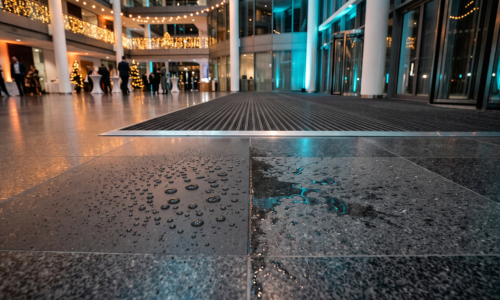
Planning a corporate holiday event introduces immediate operational risks to commercial facilities: accelerated flooring degradation, severe slip-and-fall liabilities, and rapid restroom service failures.
The solution requires a structured preventative maintenance framework executed 48 to 72 hours prior to guest arrival. Applying sacrificial floor finishes, establishing continuous NFSI-compliant wet-weather matting runs, and deploying high-frequency restroom sanitization protocols protects physical capital, limits corporate liability, and keeps year-end operational expenses predictable.
What are the primary facility risks during corporate holiday events?
Corporate holiday events compress hundreds of occupants into concentrated corporate footprints, accelerating structural wear on hard-surface flooring and luxury vinyl tile (LVT), while overwhelming commercial plumbing infrastructure. The rapid influx of street grit, moisture, beverage spills, and spiked heels compromises surface seals, degrades coefficient of friction thresholds, and creates immediate, preventable slip-and-fall liabilities.
Why does high-density event traffic permanently damage commercial flooring?
High-density event traffic damages commercial floors through localized point-load stresses and abrasive friction. Spiked heels deliver upwards of 1,500 pounds per square inch (PSI) of dynamic load, fracturing brittle floor finishes and puncturing unconditioned resilient tile. Concurrently, outdoor particulate tracked inward acts as an abrasive compound under foot traffic, mechanically stripping urethane wear layers and degrading the floor’s Static Coefficient of Friction (SCOF).
The Counter-Intuitive Insight: More Entrance Mats Can Increase Slip Liabilities
Standard facility management doctrine suggests placing short, scattered mats throughout reception corridors. In practice, standalone, unanchored 3×5-foot mats create severe tripping hazards and fail to eliminate water carryover.
Industry data indicates that stopping 90% of exterior moisture and grit requires a continuous, directional walk-off matting system of at least 15 to 20 linear feet. Placing fragmented mats without interlocking edges or weighted, beveled rubber backings elevates slip-and-fall incident rates under high-density event loads rather than reducing them.
What is the tactical pre-event preparation protocol for facility managers?
Executing an effective pre-event floor and restroom protection protocol requires a phased operational workflow beginning 72 hours prior to the event, balancing mechanical prep with chemical application.
- Substrate Cleansing and Neutralization (T-72 Hours): Rotary scrub all hard flooring surfaces using a neutral-pH cleaner to strip embedded winter particulates without compromising the existing base wax layer.
- Sacrificial Polymer Application (T-48 Hours): Apply two thin coats of a high-solids, slip-resistant acrylic polymer finish verified against ANSI/NFSI B101.1 standards to elevate dry and wet SCOF above the 0.60 safety threshold.
- Continuous Walk-Off Matting Deployment (T-24 Hours): Secure a minimum of 20 continuous linear feet of bi-level, rubber-backed scraper/wiper matting systems at all exterior ingress zones, ensuring ADA-compliant transitions.
- Restroom Fixture Stress Testing and Dosing (T-12 Hours): Hydro-jet primary waste lines, replace automated flush-valve batteries, and install enzyme-producing bio-pucks in floor drains to neutralize odor-causing anaerobic bacteria.
- Consumable Over-Allocation (T-4 Hours): Triple standard supply buffers for commercial restrooms, staging commercial-grade paper products, touch-free foaming soaps, and EPA-registered disinfectants.
How should commercial restrooms be managed during high-capacity events?
High-capacity corporate celebrations cause restroom utilization to spike by 300% to 500% over standard workday averages, creating acute bottlenecks and hygiene breakdown. Managing this surge requires shifting from periodic cleaning schedules to a continual, dynamic day-porter model governed by rigid replenishment thresholds and targeted sanitization protocols.
| Metric / Operational Area | Standard Business Hours | High-Density Corporate Event | Risk Mitigation Strategy |
| Service Frequency | Every 2 to 4 hours | Continuous / 20-minute cycles | Eliminates paper accumulation and fixture overflow |
| EPA Disinfectant Dwell Time | 5 to 10 minutes (overnight) | 60 seconds (accelerated hydrogen peroxide) | Maintains sanitization velocity without downtime |
| Matting Water Absorption | Standard carpet tiles | 1.5 gal/sq. yd bi-level matting | Prevents transfer of restroom water to lobby floors |
| Floor Slip Rating | Static DCOF > 0.42 | Static DCOF > 0.60 (NFSI certified) | Mitigates black-water slip-and-fall claims |
| Supply Reserve Buffer | 24-hour cycle inventory | 300% on-site buffer staged | Avoids stockouts during high-utilization hours |
Facility managers should integrate specialized janitorial services to monitor restroom stability throughout the event. This operational posture guarantees that touchpoints, door handles, counters, and mirrors remain dry, sanitized, and compliant with OSHA 1910.22 sanitation standards.
Internal Buy-in: How to Present This to Your Leadership
Securing budget approval for pre-holiday facility prep requires framing the investment around balance-sheet protection and enterprise risk management:
- For the CFO / Finance Director: Present the spend as preventative capital preservation. A pre-event floor prep and porter service agreement costs an average of $1,500 to $3,500. Conversely, emergency carpet extraction, tile replacement, and accelerated full-floor stripping in Q1 average $8,000 to $15,000. Frame this as a CapEx deferral strategy with an immediate 4x ROI.
- For the Risk / Legal Team: Emphasize liability mitigation under OSHA 29 CFR 1910.22 and ANSI/NFSI slip-and-fall benchmarks. The average commercial slip-and-fall claim settlement in 2025–2026 exceeds $45,000 in direct legal and medical expenses. Continuous matting and dynamic porter rotations eliminate wet-floor exposures.
- For HR & Event Stakeholders: Focus on brand perception and corporate hospitality. Unsanitary restrooms and dingy, scuffed floors reflect poorly on leadership. Professional facility preparation guarantees an executive-grade aesthetic from opening remarks to post-event departures.
Frequently Asked Questions
What Static Coefficient of Friction (SCOF) is required for event floor safety?
Can sacrificial floor sealants be applied over existing wax without stripping?
How much entrance matting is required to protect corporate flooring from winter precipitation?
How do dynamic day-porter services manage active event spaces without disrupting attendees?
Optimize Your Facility Before Holiday Celebrations Begin
Prevent permanent substrate degradation and insulate your organization against premises liability. Book a technical scoping call with your local Anago franchisee to audit your event traffic zones, deploy slip-resistant finish protocols, and secure specialized day-porter resources before Q4 calendars close.
By Darlene Bernd, Content Marketing Manager
