Regulatory expectations for commercial facility health and occupant safety are evolving rapidly. Relying on outdated sanitation benchmarks exposes facility managers to legal liability, employee absenteeism, and non-compliance penalties during mid-year operational resets.
Partnering with forward-thinking commercial cleaning facility service partners ensures immediate adaptation to updated OSHA, EPA, and CDC guidelines through continual protocol refinement and modern HEPA filtration technologies.
According to 2026 EH&S risk management projections, over 40% of commercial facilities currently operate under outdated hygiene protocols that fail to meet updated federal bio-burden standards.
Traditional vendors rarely update their operational procedures unless forced by contract renegotiations. This static approach leaves facility managers vulnerable when regulatory bodies mandate higher baseline sanitation benchmarks.
Using stronger chemical disinfectants without updating application procedures does not improve compliance. Over-application without verified dwell time often violates EPA product labels, creating federal regulatory infractions.
Facility service providers eliminate this exposure by continually updating core cleaning procedures to match evolving CDC, OSHA, and EPA guidelines.
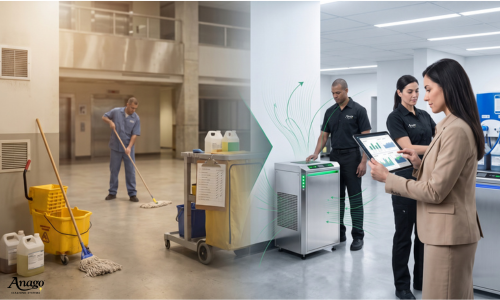
| Operational Area | Legacy Cleaning Approach | Adaptive Compliance Management |
| Regulatory Tracking | Reactive; modified only after non-compliance | Proactive; protocols updated as regulations change |
| Chemical Safety | Generic, unmonitored chemical mixing | EPA-registered formulations with precise dilution control |
| Pathogen Elimination | Surface wiping without dwell tracking | Scientific dwell-time validation for List N disinfectants |
| Air Processing | Passive ventilation filtration | Active HEPA air extraction filtering down to 0.3 microns |
To meet every regulation without missing a beat, facility leaders must execute a mid-year operational reset structured around regulatory adaptation.
Securing leadership support for regulatory adaptation requires demonstrating how proactive compliance protects corporate assets and operational continuity.
When clean is non-negotiable, adapting to regulatory changes protects both your facility’s reputation and its bottom line.
Future-Proof Your Facility Compliance. Don't let outdated standards jeopardize your facility's operational readiness. Review your current sanitation benchmarks with Anago compliance experts today.
By Darlene Bernd, Content Marketing Manager