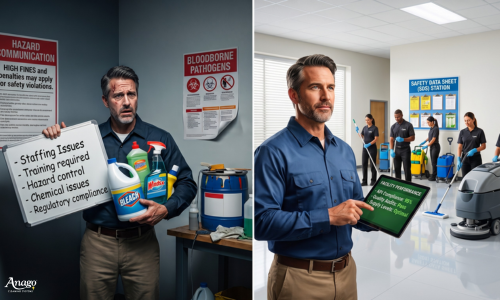
For many operations directors, property managers, and facility executives, managing an in-house janitorial service looks like an easy win for the budget. On paper, the math is straightforward: you hire a few hourly cleaners, purchase commercial maintenance supplies, and keep the entire operation under direct supervision. It feels controlled, predictable, and cost-effective.
In reality, this approach often introduces severe operational vulnerabilities that catch leadership teams off guard.
When you manage your facility’s cleaning program internally, you’re not just managing a maintenance crew. You’re also operating a highly regulated, high-risk operational department. From hidden OSHA hazard violations to slip-and-fall liabilities and constant staffing shortages, the financial impacts of non-compliance can quickly wipe out any perceived budget savings.
Understanding these structural risks is the first step toward protecting your organization’s bottom line. Transitioning to a certified, external commercial cleaning partner turns a major operational liability into a predictable, compliant asset.
Many facility leaders don’t realize that commercial cleaning is heavily regulated by state and federal authorities. When you run an in-house team, your organization shoulders 100% of the regulatory burden. If an internal team member slips up, your company faces the fines, legal issues, and long-term reputational damage.
In-house cleaning programs frequently fail compliance checks in three critical areas:
OSHA requires all organizations to maintain a comprehensive Hazard Communication program if employees work with hazardous chemicals. This includes keeping an up-to-date Safety Data Sheet (SDS) binder that is easily accessible to all staff at all times. In-house crews often use consumer-grade chemicals purchased from retail stores, or they fail to maintain proper secondary labels on diluted chemical spray bottles. These seemingly minor oversights carry hefty OSHA penalties that can reach thousands of dollars per violation.
If your facility experiences an incident involving bodily fluids, whoever cleans it up must have specific training, personal protective equipment (PPE), and access to an approved biohazard disposal process. Forcing an untrained in-house janitor to clean up a biohazard directly violates OSHA standards. It exposes your organization to severe legal liability if that employee contracts an infection or suffers an exposure incident.
Commercial-grade disinfectants require precise dilution ratios and specific contact dwell times to actually kill pathogens. In-house staff often mix chemicals by eye, leading to ineffective sanitation or, worse, toxic fumes. Mixing incompatible chemicals, such as bleach and ammonia, creates hazardous chloramine gases that can force a full facility evacuation, harm employees, and trigger an immediate visit from local safety inspectors.
Some operations directors hesitate to transition to an outsourced model because they worry about vendor-related risks. These concerns usually center around three primary questions:
These are valid questions for any facility manager to ask. However, you can easily mitigate these vendor risks through a robust Service Level Agreement (SLA) and a rigorous vetting process. Compare those manageable vendor challenges to the systemic, unmanageable liabilities of keeping your cleaning operation in-house:
| Operational Risk Category | In-House Cleaning Program | Outsourced Commercial Cleaning |
| Labor & Staffing | You must recruit, background check, onboard, and cover shifts for absent workers. | The vendor handles all staffing, background checks, and automatically sends replacement cleaners for absences. |
| Worker Injury & Workers’ Comp | A slip-and-fall or chemical burn on your cleaning team directly impacts your company’s insurance premiums. | The vendor covers their own workers’ compensation, insulating your company’s risk profile. |
| Equipment & Supply Management | You purchase, maintain, and repair expensive auto-scrubbers, vacuums, and safety gear. | The vendor provides, maintains, and replaces all commercial-grade equipment at their own expense. |
| Cross-Contamination | Untrained staff often use the same microfiber cloths to clean toilets and office desks, spreading bacteria. | Certified vendors use color-coded cleaning systems and strict protocols to eliminate cross-contamination. |
When you weigh these factors, the risks of managing an untrained, under-equipped in-house crew far outweigh the manageable challenges of oversight with a professional vendor partner.
A professional commercial cleaning partnership serves as an active shield for your organization, turning daily operations into a structured exercise in facility risk mitigation. When you transition your cleaning program to a qualified service provider, you transfer several major categories of operational risk:
If an in-house janitor mops a floor, forgets to put up a “wet floor” sign, and a visitor slips and sustains an injury, your company’s general liability policy must cover the entire claim. When you outsource, a reputable vendor provides a Certificate of Insurance (COI). If a slip-and-fall occurs while their team is managing the floor, the liability primarily falls on the vendor’s insurance carrier, protecting your bottom line and premium rates.
Professional cleaning vendors must document their employees’ safety training to maintain their own business insurance and industry certifications. They train their staff on proper ergonomics, ladder safety, chemical handling, and slip-prevention techniques. This rigorous, documented education significantly lowers the frequency of on-the-job accidents within your facility.
If an in-house cleaner calls in sick, your facility manager or operations assistant often ends up emptying trash cans and mopping floors. This diverts high-value staff from their core responsibilities. An outsourced partner guarantees daily contract coverage, keeping your facility consistently clean and operational without pulling your core team away from their primary operational duties.
To successfully mitigate vendor risk, you must establish clear, enforceable standards of cleaning vendor accountability. Do not rely on loose verbal agreements or vague contracts. Protect your facility by building accountability directly into your partnership from day one.
To calculate your true commercial cleaning ROI, you must look beyond raw hourly wages. While an in-house cleaner’s hourly pay might look lower on paper than an outsourced vendor’s billing rate, the fully loaded cost of an in-house employee tells a very different story.
Use this foundational calculation to understand your actual financial exposure:

Consider the hidden costs that a professional vendor absorbs into their contract rate:
Managing an in-house cleaning program exposes your organization to unnecessary regulatory, financial, and operational risks. By partnering with a certified, fully insured commercial cleaning vendor, you protect your business from compliance penalties, transfer your operational liability, and free up your management team to focus on growing your core operations.
Contact our facility experts today for a complimentary, no-obligation Facility Risk & Compliance Audit. Our experts will help you identify hidden liabilities and build a custom, risk-managed solution tailored to your operational goals.
By Darlene Bernd, Content Marketing Manager