For decades, commercial cleaning protocols focused almost entirely on visual appearance. If the lobby floors gleamed, the trash cans were empty, and the windows were streak-free, a facility was deemed clean. Today, that superficial standard is no longer enough. Facilities managers, property owners, and operations directors face a much more demanding environment. Building occupants, tenants, and employees expect spaces that are not just visually tidy, but biologically safe.
To meet this expectation, forward-thinking facility leaders are looking to the healthcare sector. Hospitals and clinics rely on strict, science-based cleaning systems designed to limit the transmission of pathogens. By adapting these healthcare-grade disinfection protocols for commercial business environments, you can protect your occupants, reduce absenteeism, and build deep trust with everyone who steps foot in your building.
To implement a clinical-grade clean, you must first understand the functional differences between cleaning, sanitizing, and disinfecting. These terms are often used interchangeably in casual conversation, but they mean distinct things in professional facility management:
A clinical-grade clean combines these three actions into a rigorous, repeatable system. It shifts the primary goal of environmental services from aesthetic maintenance to proactive infection prevention. In a commercial setting, this means treating high-traffic areas and shared spaces with the same systematic discipline that a hospital uses to prepare an operating or exam room.
Traditional commercial cleaning protocols often prioritize speed and surface-level efficiency. Janitorial staff frequently operate under tight time constraints, moving rapidly from room to room to cut down on operational costs. While this keeps a building looking presentable, it leaves behind invisible health risks. Standard cleaning models fail in three primary areas:
Transitioning to a clinical-grade protocol does not mean turning your office building, logistics hub, or retail space into a sterile surgical suite. Instead, it means adopting the disciplined workflows and chemical safety standards used by healthcare environmental services (EVS) professionals. You can introduce these advanced commercial cleaning protocols to your facility through a structured four-part framework.
Disinfecting every single square inch of a building with equal intensity is an inefficient use of time and budget. Healthcare facilities prioritize surfaces based on touch frequency and cross-contamination risk. You should apply this same logic to your commercial property by categorizing surfaces into distinct risk zones:
Every professional disinfectant has a manufacturer-specified “dwell time” – also known as contact time. This is the exact number of minutes the chemical must remain visibly wet on a surface to kill the pathogens listed on its label. For example, a product might require a two-minute dwell time to kill influenza, but a full ten minutes to eliminate more resilient bacterial strains.
To implement this correctly, ensure your operations team only uses products listed on the EPA’s List N or those registered to kill specific institutional pathogens. Educate your staff to read product labels specifically for contact times, and adjust cleaning schedules to allow workers the time required to let products air-dry naturally on surfaces.
Healthcare facilities prevent cross-contamination by isolating cleaning tools to specific zones. You can replicate this by using a standardized color-coded microfiber system in your commercial building:
Staff must be trained to never mix colors or move a cloth from one designated zone to another. Additionally, cloths should be changed frequently within each zone to prevent saturation and soil transfer.
Wiping down surfaces by hand is necessary for removing soil, but manual application can miss tight corners, textures, and crevices. Healthcare facilities complement manual cleaning with advanced technology, such as electrostatic sprayers.
Electrostatic sprayers apply a positive electric charge to the disinfectant droplets as they leave the nozzle. Because most environmental surfaces carry a negative or neutral charge, the droplets are magnetically attracted to the target area. The spray wraps around curved surfaces, pipes, and the undersides of furniture, providing complete, even coverage that manual wiping cannot match.
You can’t manage what you don’t measure. To run a high-trust cleaning program, you must move away from purely visual inspections and adopt objective quality assurance tools.
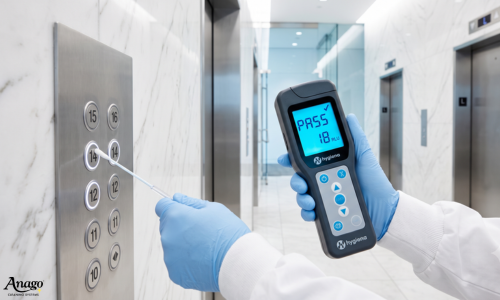
Adenosine Triphosphate (ATP) is an energy molecule present in all living cells, including bacteria, mold, and human secretions. Healthcare environments use ATP testing to instantly verify surface cleanliness.
The process is simple: a supervisor swabs a supposedly clean surface, inserts the swab into a handheld luminometer, and receives a numerical reading in Relative Light Units (RLUs) within seconds. A high RLU reading indicates that organic matter remains on the surface, meaning the cleaning protocol failed and the area must be recleaned immediately. Introducing regular, random ATP audits in your commercial facility provides clear data on whether your team is executing your protocols correctly.
Another cost-effective training tool involves using a harmless, invisible fluorescent gel to mark high-touch surfaces before the cleaning shift begins. After the cleaning team finishes, a supervisor inspects the marked areas with a UV blacklight. If the mark is gone, the worker thoroughly cleaned the surface. If the mark is still visible, the worker missed that specific touchpoint, highlighting a training gap.
Upgrading your facility’s cleaning standards requires an investment of time, thought, and resources. You will likely face a few operational hurdles during the transition.
Implementing a healthcare-grade cleaning system requires specialized knowledge, specific equipment, and a disciplined management structure. For many organizations, managing this process internally is too complex and resource-intensive. When vetting an external commercial cleaning partner, look past marketing materials and ask direct, operational questions:
A professional partner will answer these questions clearly, with data and documented procedures rather than vague assurances. By elevating your commercial cleaning protocols to a clinical standard, you do more than keep your building looking its best. You actively safeguard the health of your workforce, reduce operational risk, and create a resilient environment ready for any public health challenge.
Download our High-Touch Surface Risk Mapping Checklist for your facility.
By Darlene Bernd, Content Marketing Manager