Inconsistent execution across multi-site facilities compromises compliance and exposes organizations to severe operational risk. Standardizing infection control protocols using CDC-compliant frameworks and EPA-registered medical-grade disinfectants guarantees uniform protection, mitigates employee absenteeism, and ensures seamless regulatory alignment. Securing an elite Facility Service Partner delivers the central oversight necessary to protect human health and maintain absolute operational continuity.
Multi-site organizations frequently suffer from variable compliance execution due to localized staff turnover and fragmented vendor management. Eliminating these discrepancies requires an enterprise-level framework that locks in CDC-compliant infection control protocols universally across every facility.
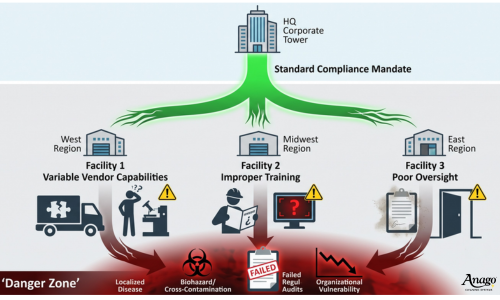
When managing multiple facilities across different regions, operational drift is an ever-present risk. While HQ might mandate strict compliance standards, individual locations often deviate due to variable vendor capabilities, improper training, or poor oversight. This variance introduces dangerous compliance gaps, leaving the organization vulnerable to cross-contamination, localized disease outbreaks, and failed regulatory audits.
To eliminate this lack of visibility, forward-thinking Operations Directors are centralizing their facility service strategies. According to corporate real estate projections for 2026, centralized facility risk-management models reduce operational variance by over 90% compared to decentralized, location-specific vendor sourcing.
Integrating advanced HEPA filtration protocols systematically mitigates airborne contaminant risks, protecting both indoor air quality and overall facility safety. Maintaining high-efficiency particulate air standards traps micro-particles, reducing cross-contamination vectors across high-traffic commercial spaces.
True infection control extends beyond surface disinfection; it demands comprehensive air chemistry management. Deploying certified HEPA filtration systems within a structured facility maintenance cadence ensures that:
Deploying EPA-registered disinfectants safely requires a strict understanding of required chemical dwell times and material compatibility matrices. Executing these protocols via automated, algorithmic workflows prevents cross-contamination while protecting building infrastructure from chemical degradation.
To build a reliable infection control wall, Facility Managers must enforce an uncompromising, scientific methodology across all properties. The following four-stage protocol guarantees consistent, high-level sanitization:
| Compliance Vector | Decentralized Janitorial Services | Standardized Corporate Facility Partnership |
| Infection Control | Superficial wiping using non-rated consumer chemicals | CDC-Compliant Disinfection via EPA-registered solutions |
| Air Quality Management | Standard vacuuming that redistributes fine dust | HEPA Filtration Integration for airborne particulate control |
| Cross-Site Accountability | Inconsistent reporting across regional operations | Centralized Dashboard Tracking with real-time digital validation |
| Workforce Continuity | High turnover leading to frequent protocol gaps | Algorithmic Workflows that automate compliance execution |
A common industry mistake is attempting to solve cross-site quality variances by simply increasing training frequency. Training is a passive intervention that fails to account for high staff turnover. Eliminating operational drift requires the absolute automation of environmental protocols via rigid, algorithmic workflow tracking.
True consistency is achieved when the process is built into the system itself, enforced by specialized software and validated by digital check-ins, making non-compliance impossible to conceal.
Securing corporate alignment for an enterprise-wide infection control program requires framing the initiative around human capital protection and risk management.
Standardize Your Corporate Infection Control Today
Eliminate operational drift and protect your workforce with an unshakeable, multi-site compliance strategy. Schedule a technical scoping call with our enterprise experts to unify your facility standards.
By Darlene Bernd, Content Marketing Manager