Commercial Restroom Hygiene Audit for Facility Managers
What is a Commercial Restroom Hygiene Audit Checklist?
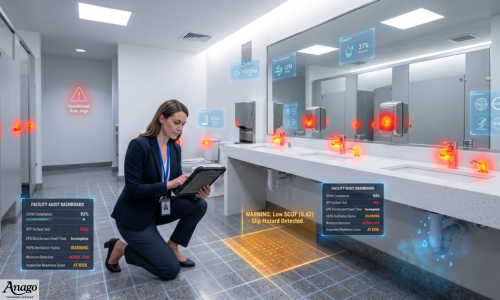
A commercial restroom hygiene audit checklist is a standardized operational framework used by facility managers to evaluate sanitation compliance, mitigate liability, and ensure continual inspection readiness. By systematically verifying surface disinfection, ventilation performance, and moisture control against OSHA and CDC standards, commercial properties eliminate cross-contamination risks, prevent slip-and-fall claims, and extend building asset lifespans.
Conventional facility management often relies on visual inspection to assess restroom cleanliness. In reality, superficial wiping without enforced disinfectant dwell times and EPA-registered chemistry redistributes micro-pathogens across high-touch surfaces. This practice creates a false sense of compliance while accelerating fixture corrosion. True risk mitigation requires verifiable chemical dwell times, ATP testing, and SCOF-compliant floor maintenance rather than cosmetic cleaning.
How Does Restroom Hygiene Impact Facility Risk and Asset Preservation?
Commercial restrooms represent the highest density of operational liability and asset degradation per square foot in any building. Unsystematic maintenance exposes property owners to regulatory enforcement from OSHA under General Duty clauses (29 CFR 1910.141), costly slip-and-fall claims, and premature capital expenditure due to surface etching and floor substrate damage. Partnering with a professional commercial cleaning service partner transforms hygiene management from a reactive janitorial expense into a structured asset preservation program.
When facility leaders fail to audit cleaning execution between scheduled inspections, operational consistency breaks down across sites. Different cleaning teams, variable execution, and missing documentation leave property managers exposed. To protect long-term asset value and maintain consistent brand standards, building operators must adopt rigorous protocols that actively mitigate risk and protect assets.
What Are the 5 Core Zones of a Restroom Hygiene Audit?
1. Floor Safety & SCOF Surface Verification
Tile and grout surfaces accumulate soap scum, grease, and moisture, creating severe fall hazards. Floor surfaces must maintain a Static Coefficient of Friction (SCOF) meeting ANSI/NFSI B101.1 standards to prevent injuries.
Audit Step 1: Inspect floor tile and grout lines for bio-film buildup and chemical buildup.
Audit Step 2: Measure slip resistance using a calibrated tribometer on high-traffic walkways.
Audit Step 3: Confirm floor drains are clear, properly trapped, and treated to prevent sewer gas backflow and bacterial harborage.
2. EPA-Registered High-Touch Surface Disinfection
High-touch surfaces (including stall latches, flush valves, faucet handles, and soap dispensers) act as transfer points for viral and bacterial pathogens if improperly sanitized.
Audit Step 1: Verify that cleaning teams use EPA-registered List N disinfectants with exact dwell times (typically 3 to 10 minutes) maintained according to manufacturer specifications.
Audit Step 2: Enforce color-coded microfiber cloth systems to prevent cross-contamination between toilets, sinks, and common touchpoints.
Audit Step 3: Test surface bio-burden using ATP (Adenosine Triphosphate) bioluminescence swabs to validate sanitation effectiveness with objective data.
3. Indoor Air Quality (IAQ) & HEPA Performance
Restroom air quality directly influences occupant health, odor control, and tenant satisfaction scores across the entire building.
Audit Step 1: Audit exhaust fan airflow rates to ensure compliance with ASHRAE Standard 62.1 mechanical ventilation rates.
Audit Step 2: Inspect air filtration systems to confirm HEPA filters are correctly fitted, clean, and operating efficiently.
Audit Step 3: Monitor ambient indoor humidity to ensure relative humidity stays below 60%, preventing mold growth and spore dispersion.
4. Moisture, Plumbing & Asset Integrity
Uncontrolled water leaks damage subfloors, corrode mounting hardware, and cause costly structural degradation over time.
Audit Step 1: Inspect wall-mounted fixtures, flushometers, and pipe penetrations for micro-leaks and structural looseness.
Audit Step 2: Check automated sensors on flush valves and faucets to reduce touchpoints, prevent water overflow, and lower utility usage.
Audit Step 3: Examine metallic and stone surface coatings for chemical etching caused by incorrect acidic cleaning agents.
Defensible recordkeeping provides proof of due diligence during regulatory audits or personal injury claims.
Audit Step 1: Verify that digital or physical service logs are signed and timestamped after every maintenance cycle.
Audit Step 2: Confirm on-site access to Safety Data Sheets (SDS) for all chemical formulations, satisfying OSHA Hazard Communication Standards (29 CFR 1910.1200).
Audit Step 3: Maintain clear service histories for restorative floor sealing, deep tile scrubbing, and drain maintenance.
How Do Restroom Maintenance Models Compare Over a 5-Year Horizon?
Choosing the right service approach directly impacts capital expenditure, liability exposure, and tenant retention. The comparison below highlights the operational trade-offs across three common facility management models.
Operational & Financial Metrics
Reactive Janitorial Wiping
In-House Basic Maintenance
Facility Service Partnership
OSHA & CDC Audit Readiness
High risk / Unverifiable
Inconsistent across sites
100% Audit-Ready Baseline
Asset Preservation (5-Yr Lifecycle)
Accelerated fixture wear
Moderate surface degradation
Maximum Asset Life Extension
SCOF Slip & Fall Liability Risk
High unmitigated exposure
Partial manual tracking
Documented Risk Mitigation
LEED v4.1 O+M Alignment
Unverified / Non-compliant
Partial compliance
Direct Support for Certification
Predictability of Operational Costs
Unpredictable CapEx spikes
Fixed labor + variable supplies
Predictable Opex Model
Internal Buy-in: How to Present This to Your Leadership
Gaining executive approval for standardized facility audits requires connecting operational practices to the financial and risk priorities of key stakeholders.
For Finance & CFOs
The Business Pitch: “Transitioning to structured restroom audits protects subfloors, fixtures, and stone surfaces from premature wear. This turns unpredictable capital repairs into a stable, optimized operational expense.”
Core Business Metric: Reduced 5-year capital replacement costs and lower facility insurance premiums.
For Legal & Risk Management Officers
The Business Pitch: “Documented SCOF friction testing and time-stamped inspection logs create verifiable records that protect against slip-and-fall claims while ensuring full OSHA compliance.”
Core Business Metric: Elimination of regulatory non-compliance fines and reduced liability claim payouts.
For Operations & Property Directors
The Business Pitch: “Standardized audit checklists eliminate service quality variations across sites, lower tenant complaints, and ensure our properties pass commercial facility inspections consistently.”
Core Business Metric: Lower tenant turnover and improved portfolio audit scores.
Frequently Asked Questions (FAQ)
How often should commercial restrooms undergo a formal hygiene audit?
Facilities should complete brief operational checklists daily, supplemented by a comprehensive, documented facility audit once per month. High-traffic properties or specialized environments should perform formal audits bi-weekly to maintain continual inspection readiness.
What is the difference between surface cleaning and bio-burden mitigation?
Surface cleaning removes visible dirt and dust from surfaces. Bio-burden mitigation uses EPA-registered disinfectants with enforced dwell times to neutralize microscopic pathogens. Complete risk mitigation requires objective verification, such as ATP swab testing, rather than relying on visual inspection alone.
How do standardized restroom protocols support LEED certification?
Standardized restroom auditing supports LEED v4.1 Operations and Maintenance (O+M) certification by enforcing green cleaning standards, using eco-friendly chemical solutions, maintaining HEPA-filtered air quality, and verifying low-flow plumbing efficiency.
Protect Your Facility Assets Today
When clean is non-negotiable, your properties require facility service partners who understand regulatory compliance and active risk mitigation. Partner with experts who deliver professional cleaning that passes inspection every time – helping you meet every regulation without missing a beat.
Download the Commercial Restroom Hygiene Audit Checklist
Necessary cookies are absolutely essential for the website to function properly. These cookies ensure basic functionalities and security features of the website, anonymously.
We use cookies to enhance your experience, analyze site usage, and support personalized content and advertising.
Manage your preferences or opt out of the sale/share of personal information.