Spend It Before You Lose It: Allocating Remaining Q4 Budgets to Deep Cleaning
 dbernd
November 4, 2026
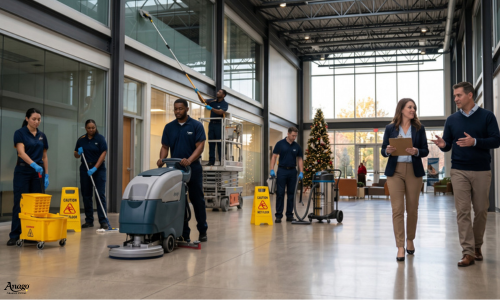
To prevent the loss of remaining annual Q4 operational funds due to “use-it-or-lose-it” fiscal policies, facility managers can capture immediate year-end ROI by reallocating surplus capital to specialized, high-value deep cleaning.
Investing in high-dusting, restorative floor care, and restroom disinfection before December 31 mitigates Q1 slip-and-fall liabilities, reduces deferred maintenance costs, and helps comply with OSHA and CDC standards – preserving your assets while shielding next year’s operational budget (OpEx) from penalties.
Why is Q4 budget reallocation to deep cleaning a critical strategic priority?
As the fiscal year draws to a close, Facility Managers and Operations Directors frequently face “use-it-or-lose-it” budget mandates. Allowing unspent funds to expire often results in reduced budget allocations for the upcoming fiscal year, as financial controllers interpret the surplus as decreased operational need.
Reallocating these remaining Q4 funds to deferred specialty cleaning projects, specifically restorative floor care, high-dusting, and electrostatic disinfection, isn’t merely a way to exhaust a budget; it’s a strategic asset preservation initiative.
Delaying these services until Q1 or Q2 when wear-and-tear peak can lead to accelerated substrate degradation, increased safety hazards, and costlier emergency remediations. By utilizing surplus funds now, you address necessary deferred maintenance, reduce future capital expenditures (CapEx), and fulfill your duty of care without impacting your next annual budget.
What are the high-ROI “surplus-ready” deep cleaning services?
When reallocating year-end funds, prioritize services that extend the lifespan of physical assets, enhance occupant safety, and satisfy regulatory standards:
- Restorative Floor & Carpet Care Severe winter weather, salt, and holiday foot traffic cause accelerated wear on hard and soft surfaces. Restorative services, such as stripping, waxing, and deep extraction, protect subfloors, improve slip resistance, and enhance aesthetic appeal.
- High-Dusting & HVAC Vent Cleaning Over time, dust, allergens, and particulate matter collect on elevated surfaces, rafters, and ductwork. High-dusting using specialized equipment removes these hazards, improving indoor air quality (IAQ) and reducing fire risks while ensuring compliance with OSHA standards.
- Restroom Disinfection & Grout Restoration Deep cleaning and high-pressure extraction remove deeply embedded contaminants from tile and grout, addressing bio-burdens that standard daily cleaning misses.
- Window & High-Access Exterior Cleaning Removing accumulated grime and environmental pollutants prevents etching and structural damage to glass and facades, preserving exterior surfaces.
How to map remaining funds to specific deep cleaning interventions
Use this matrix to identify high-ROI projects based on the scale of your remaining budget:
| Budget Range | High-ROI Service Opportunity | Asset Preservation Benefit | Liability & Compliance Mitigation |
| Micro-Surplus ($1,500 – $5,000) | Touchless restroom deep cleans & carpet hot-water extraction | Extends carpet fiber life and prevents permanent grout staining | Mitigates indoor biological hazards; meets CDC standards |
| Moderate Surplus ($5,000 – $15,000) | Hard-surface stripping & waxing; high-dusting in common areas | Protects high-traffic VCT/stone from abrasive winter wear; improves IAQ | Reduces slip-and-fall risks (SCOF standards); removes OSHA-regulated dust accumulation |
| Substantial Surplus ($15,000+) | Full facility deep resets; multi-surface restoratives; high-access cleaning | Restores facility to baseline; prevents accelerated degradation across structural assets | Lowers overall regulatory non-compliance risks; provides comprehensive audit-readiness |
Industry Correction: Why delaying “non-urgent” cleaning to Q1 is a financial mistake
A common misconception among procurement and financial officers is that deferred cleaning can be indefinitely delayed to Q1 without penalty.
This approach often backfires. Deferring floor resurfacing, high-dusting, or HVAC cleaning until the new year allows grit, pollutants, and debris to wear down materials and surfaces, which can lead to permanent damage. The cost of stripping, repairing, or replacing worn substrates in Q1 often exceeds the cost of a proactive Q4 preventative reset by up to 300%.
Additionally, delayed service often leads to scheduling conflicts, as service providers face high demand in early Q1 from organizations trying to catch up on deferred tasks.
Internal Buy-in: How to Present This to Your Leadership
To secure internal approval for Q4 budget reallocation, you must address the distinct priorities of different stakeholders:
- For the CFO & Finance (The Opex/CapEx Argument): Show that investing remaining operational funds now prevents losing them while reducing future capital expenditures on premature asset replacements. Stress that taking a proactive approach helps lower slip-and-fall liabilities, protecting the organization from unexpected costs.
- For the COO & Operations (The Disruption Argument): Highlight that schedule flexibility is much higher during year-end transitions or holiday closures, allowing for deep cleaning with minimal impact on daily operations.
- For HR & Risk Management (The Compliance/Safety Argument): Explain how these efforts help meet OSHA and CDC guidelines, reducing winter safety hazards and absenteeism.
How can you customize and execute your Q4 deep cleaning plan?
Executing a successful year-end deep cleaning project requires a structured, time-sensitive approach:
1. Audit High-Wear Areas
├── Inspect high-traffic floors, elevated structures, and HVAC vents.
└── Review recent maintenance backlogs.
2. Secure Buy-In & Allocate Remaining Funds
├── Present the asset-preservation and liability-mitigation ROI to stakeholder leadership.
└── Validate that remaining Q4 budgets can be reallocated immediately.
3. Partner with an Experienced Commercial Service Provider
└── Contact a specialized provider like Anago to assess and tailor a plan.
4. Schedule to Minimize Operational Disruption
├── Coordinate heavy-duty projects during holiday shutdowns or off-peak hours.
└── Focus on high-impact areas like lobbies, restrooms, and industrial spaces.
Anago connects you with local, independently owned franchise owners who understand these timelines and can deliver customized commercial cleaning services and restorative commercial floor care services. From stripping and waxing to deep disinfection, we make it easy to protect your facility and put your Q4 budget to work before it disappears.
Frequently Asked Questions
How does allocating Q4 budget to deep cleaning protect next year’s budget?
What are the high-priority deep cleaning services for year-end?
What regulatory standards are addressed by Q4 deep cleaning?
Don't let your remaining Q4 budget expire. Contact us today to request a custom deep cleaning estimate or schedule a year-end walkthrough to assess your needs.
By Darlene Bernd, Content Marketing Manager
