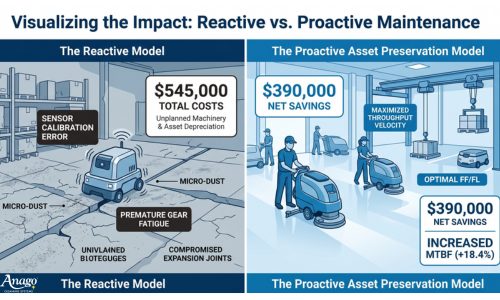
To maintain maximum supply chain velocity and protect capital expenditures in 2026, modern logistics facilities must transition from reactive janitorial maintenance to structured asset preservation. Outsourcing environmental risk management to specialized Facility Service Partners directly correlates with decreased machinery failure rates, minimized floor deterioration, and verifiable operational ROI. By standardizing high-frequency removal of airborne particulates and industrial residues, logistics leaders ensure sustained throughput and long-term infrastructure stability.
In large warehouse facility cleaning, airborne dust and microscopic debris are frequently mischaracterized as superficial aesthetic issues. In reality, fine industrial particulates act as micro-abrasives that infiltrate sensitive electronic components, optical sensors, and conveyor mechanical bearings. When left unmanaged, this accumulation accelerates equipment degradation, leading to unscheduled operational downtime and premature capital expenditure outlays for machinery replacement.
Modern fulfillment environments increasingly rely on sophisticated automation. Ambient dust settling on automated guided vehicle (AGV) optics or conveyor sorting sensors triggers systemic faults. Data collected across managed facilities indicates that a mere 0.5mm layer of industrial dust can increase component operating temperatures by up to 15%, substantially reducing the mean time between failures (MTBF) for critical infrastructure.
Industry Correction: Contrary to common industry assumptions, standard sweeping compounds do not mitigate dust; they merely redistribute micro-particles into the upper rafters of a facility. True asset preservation requires specialized HEPA-filtered extraction systems that permanently remove particulates from the environment, protecting both the facility structure and the machinery within.
Implementing a rigorous sanitation protocol preserves physical infrastructure and mitigates long-term depreciation. Floors, structural steel, and HVAC systems represent significant capital investments that require continual protection from industrial cross-contamination and chemical degradation.
Industrial concrete slabs subjected to heavy forklift traffic suffer from continuous tire-marking and chemical etching. Standard cleaning agents often break down the top sealants, exacerbating concrete dusting. Specialized facility service commercial cleaning partners utilize industrial degreasers and restorative sealants that protect the slab’s integrity, ensuring compliance with SCOF standards and preventing subfloor fracturing.
Investing in a dedicated environmental preservation program must be viewed through the lens of cost mitigation and operational upside. The table below outlines the direct financial impacts observed across mid-to-large-scale logistics hubs when shifting from internal, untrained labor to specialized partners.
| Financial Metric | Internal Generalist Cleaning | Anago Facility Service Partnership | Operational & ROI Impact (Projected 2026) |
| Average Conveyor Sorter Uptime | 94.2% | 99.1% | +4.9% Uptime; translates to ~430 additional operating hours annually. |
| Floor Slab Repair Frequency | Every 24 Months | Every 60 Months | Mitigates concrete grinding and resealing costs by 60%. |
| HVAC Filter Lifetime | 45 Days | 120 Days | Reduces mechanical maintenance overhead and energy consumption by 12%. |
| OSHA Non-Compliance Infractions | Variable Risk | Zero Infractions | Eliminates statutory fines related to environmental dust accumulations. |
Securing budget approval for specialized environmental maintenance requires aligning the priorities of multiple corporate stakeholders. While the Facility Manager prioritizes day-to-day operational fluidity, executive leadership requires a business case rooted in risk reduction and financial efficiency.
Accumulated airborne dust settles on the optical arrays and proximity sensors of automated guided vehicles (AGVs) and sorting lines, causing false tracking errors and system shutdowns. Specialized environmental preservation keeps these precision interfaces clear, maintaining automated throughput without interruption.
Standard commercial services lack the heavy machinery, safety training, and regulatory knowledge required for industrial plants. They often use incorrect chemical formulations that degrade concrete sealants or fail to comply with OSHA high-rafter dust accumulation limits, increasing corporate liability.
While floor-level remediation must occur daily to maintain SCOF standards, high-rafter dust extraction and structural steel maintenance should be executed on a semi-annual schedule. This frequency prevents the accumulation of combustible dust configurations that violate safety regulations.
Protecting your capital investments requires more than superficial maintenance. Our specialized protocols are designed to safeguard your machinery, protect your floor slabs, and ensure your logistics hub operates at peak capacity. Partner with a team that understands industrial assets.
Next Step: Book a Technical Scoping Call to analyze your facility's environmental footprint.
By Darlene Bernd, Content Marketing Manager