
Year-End Medical Office Disinfection: Preparing for Winter Viruses and Compliance Audits
 dbernd
November 11, 2026
Outpatient clinics, ambulatory surgical centers, and medical office buildings (MOBs) confront intersecting risks in Q4: aggressive winter respiratory pathogens (Influenza, RSV, SARS-CoV-2, Norovirus) and unannounced year-end accreditation audits by The Joint Commission (TJC) or state departments of health.
Preserving clinical continuity requires transitioning from basic custodial upkeep to validated, hospital-grade environmental infection control.
By implementing targeted terminal cleaning, establishing verifiable chemical contact times, and maintaining rigorous terminal cleaning logs, healthcare facility directors protect patient outcomes, safeguard staff, and ensure regulatory compliance.
What are the core clinical requirements for year-end medical cleaning audits?
Year-end clinical cleaning audits focus on the objective validation of environmental hygiene across clinical contact zones, waiting areas, and procedure rooms. Surveyors audit strict compliance with CDC Environmental Infection Control Guidelines, verify that all chemical agents maintain active EPA-registered hospital-grade approvals (List N, List Q), inspect Safety Data Sheet (SDS) accessibility, and review documented staff training on validated wet-contact dwell times.
Why are outpatient facilities vulnerable to winter pathogen surges?
Unlike acute-care hospitals with negative-pressure isolation wards, outpatient facilities feature shared airflow and dense, continuous patient turnover across waiting rooms and triage corridors. Winter respiratory viruses and gastrointestinal pathogens persist on porous and non-porous environmental surfaces for extended periods – Norovirus remains infectious on hard surfaces for up to several weeks, while Influenza and Coronaviruses remain viable on laminated check-in desks and armrests for up to 48 hours.
According to healthcare epidemiological projections for the 2026–2027 winter respiratory season, ambulatory facilities experiencing cross-contamination events face average absenteeism rates among clinical staff of 14% to 18%, substantially impairing clinical billing capacity. Mitigating this risk requires strict alignment with CDC standards for environmental surface cleaning, prioritizing broad-spectrum virucidal agents over standard commercial sanitizers.
The Counter-Intuitive Insight: Wiping Surfaces Dry Immediately Negates Disinfection
A prevalent and dangerous practice in medical facility maintenance is applying an EPA-registered disinfectant and immediately buffing or wiping the surface dry.
Disinfection is governed by chemical kinetics: if a product label stipulates a 5-minute or 10-minute wet-contact dwell time, removing the active agent before that duration lapses reduces the microbial kill claim from a hospital-grade 99.999% (log-5 reduction) to basic mechanical cleaning. This common procedural error leaves high-risk pathogens viable and results in immediate audit citations during surveyor environmental tracer inspections.
What protocols are required for clinical terminal cleaning and disinfection?
Terminal cleaning requires an aggressive, multi-step sanitization protocol designed to eradicate all pathogenic bioburden within clinical examination and procedure rooms.
- Top-to-Bottom, Clean-to-Dirty Progression: Technicians must systematically process rooms starting from highest vertical surfaces downward, cleaning low-risk zones before addressing high-touch patient contamination vectors (exam tables, diagnostic monitors, Mayo stands, phlebotomy chairs).
- Gross Soil Mechanical Cleansing: Disinfectants are rendered inactive by blood, proteins, and bodily fluids. Surfaces must first undergo mechanical cleansing with an enzymatic or neutral surfactant to eliminate biological films before chemical disinfection is applied.
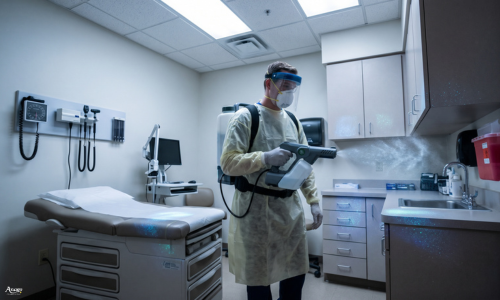
- Electrostatic Application for Complex Geometries: Apply electrostatic spray technology utilizing an EPA-registered hospital-grade disinfectant across difficult-to-access equipment, providing 360-degree wraparound coverage with micron-sized droplets that maintain wet dwell times without pooling.
- Bio-Shield and Surface Barrier Application: Treat high-contact touchpoints (door hardware, push plates, nurse station work surfaces) with persistent antimicrobial surface protectants that inhibit microbial colonization between daily servicing cycles.
- ATP Bioluminescence Quality Assurance: Systematically swab critical surfaces using Adenosine Triphosphate (ATP) meters. Surfaces registering over 25 Relative Light Units (RLU) must immediately be re-cleaned, re-disinfected, and re-tested to establish a definitive, audit-ready compliance record.
How do medical disinfection technologies and chemistries compare?
Selecting chemical formulations for clinical environments requires balancing pathogen kill spectrums, contact speed, surface material compatibility, and human safety factors.
| Active Disinfectant Chemistry | EPA Registration / Target Pathogens | Required Wet Contact Time | Surface Substrate Compatibility | Audit Compliance Risk Factor |
| Accelerated Hydrogen Peroxide (AHP) | Broad Virucidal, Bactericidal (List N, Q) | 1 to 3 minutes | High (non-corrosive to plastics, vinyl, steel) | Minimal (No toxic residues; zero VOC compliance) |
| Quaternary Ammonium (Quats – 4th Gen) | Enveloped Viruses, MRSA, VRE | 3 to 10 minutes | Moderate (can cause buildup, degrades clear acrylics) | Moderate (Dwell time non-compliance is common) |
| Sodium Hypochlorite (Bleach 1:10) | Sporicidal (C. diff), Non-Enveloped Viruses | 4 to 5 minutes | Low (highly corrosive to metal; fades fabrics) | High (Corrosion damage, eye/respiratory irritation) |
| Peracetic Acid / Hydrogen Peroxide Blend | Full Sporicidal, Mycobactericidal, Virucidal | 2 to 5 minutes | High on stainless steel; distinct pungent odor | Low (Leaves no residue; rapid decomposition to water/O2) |
Incorporating specialized medical commercial cleaning services ensures that clinical spaces use EPA-registered hospital disinfectants properly, matching specific chemical chemistries to pathogen profiles while safeguarding delicate medical devices.
Internal Buy-in: How to Present This to Your Leadership
Presenting environmental hygiene upgrades to clinical governance and executive leadership requires an audit-centric, risk-weighted strategy:
- For the Chief Medical Officer (CMO) & Infection Preventionist: Emphasize infection prevention and staff retention. Winter staffing shortages can compromise clinical operations. Upgrading terminal cleaning protocols and enforcing dwell times directly curtails healthcare-associated transmission of seasonal viruses, preserving clinical care continuity.
- For the Compliance / Accreditation Director: Frame the investment around risk mitigation during unannounced Joint Commission (TJC), CMS, or OSHA 1910.1030 (Bloodborne Pathogens) reviews. Providing quantitative ATP bioluminescence logs and documented terminal disinfection workflows satisfies the “Environment of Care” standards, eliminating findings that jeopardize accreditation.
- For the Practice Administrator / Chief Financial Officer: Position the program as revenue and reputation assurance. Outpatient cancellation rates climb during winter viral surges. Clean, audit-compliant spaces protect patient throughput and safeguard practice reputation across public review platforms.
Frequently Asked Questions
What constitutes an “audit-ready” environmental cleaning record in healthcare?
What is the clinical difference between sanitizing and disinfecting in a medical office?
Why is electrostatic disinfection superior to conventional manual wiping for winter virus control?
How often should ATP bioluminescence monitoring be performed in outpatient settings?
Insulate Your Practice Against Infection Surges and Audit Deficiencies
Ensure clinical continuity, regulatory alignment, and patient safety throughout the winter viral peak. Request a Clinical Disinfection Assessment to implement hospital-grade terminal sanitation and establish audit-ready compliance tracking for your medical offices.
By Darlene Bernd, Content Marketing Manager
