Substandard commercial facility maintenance directly escalates corporate liability exposure through slip-and-fall incidents, regulatory non-compliance fines, and accelerated asset degradation. By treating environmental hygiene as a data-driven risk management strategy, Operations Directors achieve measurable liability mitigation and secure clear financial ROI gains. Partnering with professional commercial cleaning facility partners standardizes execution, ensuring continual compliance and protecting your bottom line.
Substandard facility maintenance transforms physical environments into active legal liabilities. When organizations fail to enforce strict environmental protocols, they increase their exposure to slip-and-fall litigation, cross-contamination claims, and severe financial penalties from regulatory bodies like OSHA.
For Property Managers and Facility Operations Directors, liability mitigation is a primary operational objective. A single missed maintenance protocol can trigger an expensive chain of custody dispute, insurance premium hikes, or a debilitating lawsuit. For example, failing to maintain consistent floor safety protocols can result in major slip-and-fall incidents, which remain a leading cause of workers’ compensation claims and public liability suits in 2026.
By working with an elite Facility Service Partner, organizations insulate themselves from these operational vulnerabilities. Implementing standardized, repeatable processes creates a transparent audit trail that demonstrates an ironclad adherence to industry safety benchmarks.
Maintaining verifiable Static Coefficient of Friction (SCOF) standards ensures that facility floor surfaces deliver adequate traction to prevent slip-and-fall injuries. Consistently measuring and documenting SCOF metrics mitigates premises liability risks and establishes a robust legal defense against negligence claims.
Floor maintenance involves scientific calibration rather than aesthetic upkeep. The American National Standards Institute (ANSI) and professional safety boards place heavy emphasis on maintaining proper traction metrics. When a facility partner systematically monitors these friction levels, the organization benefits from:
Strategic facility care delivers measurable capital savings by shifting maintenance budgets from emergency remediation to predictable, preventative interventions. This operational pivot extends the operational lifespan of facility infrastructure, directly enhancing corporate profitability and stabilizing operational expenditures.
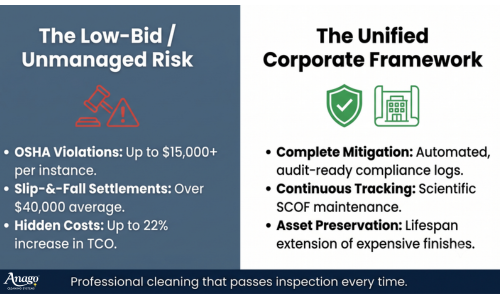
Many organizations look at environmental upkeep strictly as an operational cost center. This perspective ignores the financial advantages of asset preservation. The following data details the fiscal impact of transitioning from uncoordinated, local janitorial services to a unified corporate facility framework:
| Liability Risk Factor | Financial Exposure (Unmanaged) | Protection Level (With Facility Service Partner) |
| Regulatory Non-Compliance | Up to $15,000+ per individual OSHA violation | Complete Mitigation via automated documentation |
| Slip-and-Fall Incidents | Average settlement costs exceeding $40,000 | High Protection via continuous SCOF tracking |
| Premature Asset Replacement | Hundreds of thousands in unplanned CapEx | Asset Preservation via certified material protocols |
| Cross-Contamination/Illness | Drastic drops in operational productivity | Risk Reduction via CDC-aligned sanitization |
Treating facility management as a variable operational expense to be minimized via low-bid contracting actually increases the total cost of ownership (TCO) by up to 22%. Cheap, unvetted vendors routinely save costs by deploying untrained personnel and uncalibrated chemicals. This leads to accelerated asset destruction, missing compliance logs, and elevated liability risks. True fiscal stewardship prioritizes certified execution that guarantees risk mitigation and reliable ROI gain over short-term budget cuts.
Securing executive endorsement for a high-compliance facility strategy requires framing the proposal as a proactive risk-mitigation initiative rather than a standard vendor switch.
Mitigate your operational risks and safeguard your capital assets with a data-driven facility strategy. Download our Corporate Risk & Liability Mitigation Guide, or connect with our technical specialists to schedule a facility risk assessment.
By Darlene Bernd, Content Marketing Manager