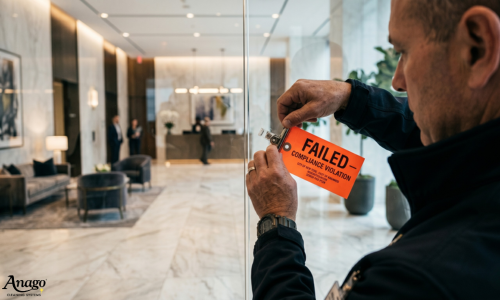
The Mid-Year Facility Audit Trap: 3 Janitorial Gaps That Risk a Failed Inspection
As corporate real estate executives and operations leaders cross the mid-year threshold, operational scrutiny intensifies. While daily maintenance keeps facilities looking orderly, a formal regulatory walkthrough evaluates infrastructure, safety protocols, and systemic compliance – areas where cosmetic cleanliness cannot mask operational vulnerabilities.
For shared corporate workspaces, multi-tenant environments, and high-foot-traffic retail hubs, passing an inspection requires moving past subjective standards of “clean” and adopting an objective framework of regulatory compliance. When an inspector walks your property, they look beyond polished floors to evaluate underlying physical risks that threaten occupant safety and business continuity.
What are the most common janitorial compliance failures during a facility audit? Overlooked high-touch cross-contamination zones, poor janitorial documentation, and improper chemical storage represent the most frequent infrastructure compliance failures discovered during regulatory facility walkthroughs.
To protect your organization from unexpected operational friction, let’s break down these high-risk areas and outline an actionable mid-year facility audit checklist designed to uncover hidden vulnerabilities before they turn into costly citations.
The Mid-Year Facility Audit Checklist: Critical Focus Areas
1. Egress Maintenance and Unobstructed Pathways
During a compliance audit, hallways and exit routes are heavily scrutinized by both safety inspectors and local fire marshals. Janitorial carts, floor buffers, commercial vacuum cleaners, or staging supplies left temporarily in corridors constitute immediate commercial building compliance gaps.
Under OSHA standard 1910.37, exit routes must remain free and unobstructed at all times. A common operational failure occurs when cleaning crews treat wide hallways or alcoves as temporary staging zones while servicing a floor. Even a temporary obstruction during business hours can lead to immediate fines.
The Standard: All emergency exit pathways, exit doors, and structural corridors must remain completely unobstructed. Equipment must be actively in use or stored in designated utility zones.
Self-Assessment: Are your cleaning teams staging equipment in active corridors, or are they utilizing designated utility closets and keeping liabilities out of active hallways?
Action Step: Establish clear staging protocols that forbid leaving equipment unattended in exit pathways for even short periods. Ensure all rolling stock has assigned parking areas inside utility closets.
2. Cross-Contamination Control Zones
Standard corporate real estate sanitation often fails by utilizing the same microfiber cloths, flat mops, or cleaning solutions across disparate hygiene ecosystems. Using the same equipment to service a high-density breakroom after clearing a multi-stall restroom is a major threat to public health.
Regulatory walkthroughs look closely at environmental services workflows. If an inspector or a client auditor observes an environmental technician using a single cloth on multiple surfaces, your entire sanitation protocol is compromised. Visual cleanliness does not equate to biological safety.
The Standard: A strict, color-coded material system must be enforced to prevent the mechanical transfer of pathogens across facility zones. Red textiles are typically reserved for high-risk restroom fixtures, yellow for lower-risk restroom surfaces, blue for general office dusting, and green for food preparation zones.
Self-Assessment: Can your current environmental services team explicitly demonstrate their cross-contamination prevention protocol and identify the color-coding framework under pressure?
Action Step: Verify that your cleaning supplier provides distinct, color-coded materials and that employees are audited regularly on zone containment. Post color-key guides inside all janitorial supply closets.
3. Chemical Management and Storage Infrastructure
Improper chemical management is a primary driver of common inspection failures. Regulatory inspectors frequently cite facilities for secondary containers lacking OSHA-compliant labels, unorganized chemical closets, or missing safety documentation.
Under the OSHA Hazard Communication Standard (29 CFR 1910.1200), every container holding a hazardous chemical must be clearly labeled. This includes simple spray bottles filled from a central chemical dilution station.
The Standard: Every chemical container must be clearly labeled with its specific identity, manufacturer warnings, and global harmonization system (GHS) pictograms. Storage areas must be well-ventilated, cleanly organized, and secured against unauthorized occupant access.
Self-Assessment: Walk your utility closets today. Are there unlabeled spray bottles, mixed solutions with no identification, or outdated chemicals sitting on structural shelves?
Action Step: Audit all chemical closets. Purge unlabeled bottles and ensure that automated dilution stations are functioning properly with clear, pre-printed secondary labels available for immediate use.
Mapping Vulnerabilities Across Diverse Real Estate Portfolios
Compliance risks are not uniform across all property types. A facility manager must understand how structural differences alter your risk profile during a formal evaluation.
Facility Type
Primary Compliance Risk Area
Operational Consequence
Actionable Mitigation Strategy
Shared Corporate Workspaces
Cross-contamination in high-density hot-desking zones and shared phone pods.
Increased workforce absenteeism, suppressed productivity, and localized outbreaks.
Implement targeted day-porter touchpoint disinfection protocols during peak office hours.
Multi-Tenant Environments
Inconsistent cleaning documentation across common areas, elevator lobbies, and entryways.
Tenant churn, lease disputes, and liability exposure during legal or regulatory discovery.
Deploy digital, time-stamped validation logs accessible via QR codes in public zones.
Retail & Commercial Hubs
Egress obstructions and slip, trip, and fall hazards during peak operating hours.
Direct regulatory fines, immediate litigation risks, and spikes in corporate insurance premiums.
Establish strict off-hours floor maintenance windows and enforce rigid wet-floor signage rules.
Executing the Mid-Year Audit: A Step-by-Step Framework
To guarantee your property stands up to external regulatory scrutiny, don’t wait for an unannounced inspector to arrive. Follow this operational checklist to execute a proactive internal walkthrough:
Phase 1: Document Verification
Verify that your central hazard communication binder is complete and placed in a visible location.
Confirm that all janitorial technicians have documented proof of safety training on file.
Review service logs to ensure cleaning frequencies match your building’s tenancy requirements.
Phase 2: Physical Inspection
Walk every emergency exit route and verify that no cleaning carts or supplies create structural bottlenecks.
Inspect every secondary spray bottle in use; immediately discard any container lacking a compliant label.
Check the ventilation and lighting within janitorial closets to ensure safe operating conditions.
Phase 3: Behavioral Verification
Observe your cleaning staff during a live shift to confirm proper glove-changing intervals.
Verify that separate mop heads are used for restrooms versus general office floors.
Confirm that technicians are allowing proper chemical application times before wiping surfaces.
Transitioning from a reactive cleaning posture to a proactive compliance strategy protects your infrastructure, secures your workforce, and satisfies all regulatory cleaning requirements. True operational security is achieved when physical execution matches administrative standards perfectly.
Facility Audit and Compliance FAQ
What happens if an inspector finds an unlabeled cleaning chemical container?
An unlabeled secondary container is a direct violation of OSHA’s Hazard Communication Standard. Inspectors can issue citations and financial penalties depending on the severity and history of the facility’s compliance gaps. All secondary bottles must carry pre-printed GHS labels detailing chemical identities and associated hazards.
How wide must facility exit routes remain to stay compliant with OSHA?
According to OSHA regulations, an exit route must be at least 28 inches wide at all points. No janitorial equipment, carts, or cleaning supplies can scale down this corridor space, even temporarily, as it poses an immediate hazard during emergency evacuations.
Why do standard visual property audits fail to catch safety compliance risks?
Visual audits focus primarily on cosmetic aesthetics, such as clear glass or dust-free surfaces. They regularly miss structural risks like hidden cross-contamination, expired safety logs, improper chemical mixing, and uncertified personnel workflows.
How often should a facility update its internal janitorial audit checklist?
Your internal audit checklists should be reviewed annually or whenever a significant change occurs in your building’s tenancy, chemical usage, or regional safety regulations. This ensures that your local operational protocols align perfectly with macro regulatory shifts.
Don’t leave your next inspection to chance – reach out to Anago experts today
Necessary cookies are absolutely essential for the website to function properly. These cookies ensure basic functionalities and security features of the website, anonymously.
We use cookies to enhance your experience, analyze site usage, and support personalized content and advertising.
Manage your preferences or opt out of the sale/share of personal information.