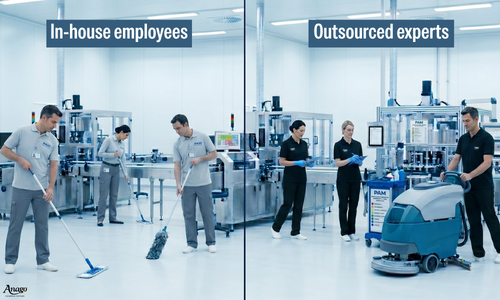
The decision between in-house and outsourced manufacturing facility cleaning is fundamentally a financial and operational risk decision, not a staffing preference. In most manufacturing environments, outsourced facility service partners deliver stronger ROI through improved consistency, reduced downtime risk, better compliance alignment, and lower hidden operational costs.
While in-house teams offer perceived control, outsourced models typically provide greater scalability, training depth, and accountability under standards aligned with OSHA, EPA, and ISO frameworks.
Manufacturing environments operate on tight production schedules where even minor inefficiencies can escalate into significant financial losses.
Cleaning performance directly impacts:
A poorly structured cleaning model (whether internal or external) introduces variability that manufacturing systems are not designed to absorb.
At first glance, in-house cleaning appears more controllable. However, total cost of ownership is often underestimated.
Direct Costs Include:
Hidden Costs Include:
Most facilities underestimate in-house cleaning costs by 20–40% when indirect labor, supervision time, and operational inefficiencies are fully accounted for.
Outsourced facility service partners convert cleaning into a predictable operating expense (OPEX) model.
Benefits include:
Consistency is one of the most important performance differentiators in manufacturing cleaning.
In-House Model Challenges:
Outsourced Model Advantages:
Facilities aligned with ISO 9001 frameworks often prefer outsourced partners due to stronger process documentation and audit readiness.
Safety and compliance are non-negotiable in manufacturing environments.
Key Regulatory Anchors:
In-House Risks:
Outsourced Advantages:
Manufacturing demand fluctuates based on seasonality, product cycles, and customer demand.
In-House Limitations:
Outsourced Strengths:
ROI in cleaning is not measured by service cost alone – it is measured through operational outcomes.
| Factor | In-House Model | Outsourced Model |
| Labor Cost Predictability | Low | High |
| Downtime Risk | Higher | Lower |
| Compliance Readiness | Variable | Structured |
| Training Depth | Limited | Standardized |
| Scalability | Low | High |
ROI Insight
Outsourced models often reduce total operational costs by improving uptime, reducing maintenance frequency, and minimizing compliance risks – even when monthly service costs appear higher.
Manufacturing assets are highly sensitive to contamination, dust, and improper maintenance.
Outsourced providers typically bring:
HEPA Filtration environments benefit significantly from structured cleaning systems that reduce airborne contamination affecting sensitive equipment.
Operations Leaders focus on uptime stability and workforce flexibility
Finance Teams focus on total cost of ownership and risk-adjusted ROI
Safety Teams focus on OSHA compliance and incident reduction
Executive Leadership focus on operational resilience and scalability
Framing the decision through risk and performance (not staffing preference) increases alignment and decision speed.
Improve operational efficiency and reduce hidden risk by evaluating a structured facility service partnership model. Explore Manufacturing Facility Cleaning Services today.
By Darlene Bernd, Content Marketing Manager