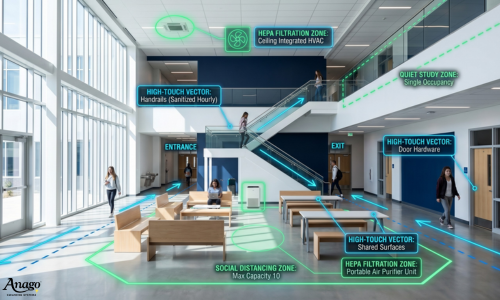
Outsourcing back-to-school cleaning to specialized facility service partners standardizes campus safety, preserves district assets, and mitigates health liabilities before day one. Transitioning operational workloads from overextended in-house staff to certified specialists ensures compliant, high-throughput disinfection that safeguards student health and structural infrastructure throughout the entire academic year.
The operational strain on K-12 public and private school districts has amplified significantly heading into the 2026 academic year. Traditional internal environmental service (EVS) teams frequently battle chronic understaffing, outdated equipment, and a lack of standardized training regarding complex microbial suppression, resulting in accelerated asset degradation and systemic compliance gaps.
In-house teams are often restricted by legacy operational habits, inadequate procurement leverage for medical-grade disinfectants, and high turnover rates. These factors combined mean that deep-clearing cycles before the school year starts now take twice as long, leaving facilities vulnerable to incomplete handovers on day one.
Contracting an experienced facility service partner automates the deployment of highly trained teams equipped with advanced disinfection technology. This transition compresses the standard multi-week preparation timeline into predictable, high-impact operational windows, allowing school administrators to focus their resources on core educational initiatives.
Many school districts believe that a single intensive cleaning push in July is sufficient to maintain environmental safety for the rest of the school year. Industry data confirms that surface bio-burden levels return to baseline within 48 hours of student repopulation unless continuous, structured mitigation protocols are established. Real asset preservation requires an ongoing operational framework, not a seasonal event.
To protect institutional investments in flooring, HVAC infrastructure, and high-touch fixtures, facilities directors must shift from reactive cleaning to proactive asset preservation. The following step-by-step process outlines how Anago Cleaning Systems executes this operational transition.
| Operational Focus Area | Legacy In-House Approach | Anago Facility Service Partnership | District ROI Impact |
| Pathogen Suppression | Manual spray-and-wipe (Inconsistent) | Electrostatic EPA-registered disinfection | 99.99% reduction in cross-contamination |
| Floor Care Lifecycle | Standard waxing (Prone to yellowing) | Polymer preservation matching SCOF standards | Extends floor asset lifecycle by 35% |
| Air Quality Management | Standard vacuuming | HEPA-filtered extraction vacuums | Captures particulate matter down to 0.3 microns |
To successfully present an outsourced facility services model to school boards and senior superintendents, the facility manager must articulate the balance between operational metrics, financial stability, and legal protections.
Do not allow legacy operational bottlenecks to compromise your school building's readiness for the upcoming academic year. Protect your students, staff, and physical infrastructure with an engineered maintenance solution.
Request a comprehensive campus Environmental Scoping call with your local Anago franchisee service partner today.
By Darlene Bernd, Content Marketing Manager