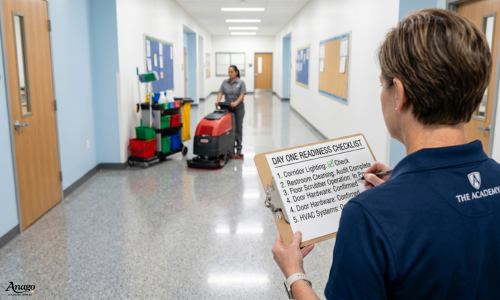
For educational administrators, facility managers, and school board members, the start of a new academic year represents more than a logistical feat – it’s a critical test of operational readiness. When the first bell rings, a school’s physical environment instantly becomes its most visible statement of care, safety, and institutional competence.
Every hallway, classroom, and cafeteria must look pristine and operate at the highest standards of environmental hygiene. Managing the physical infrastructure of an educational institution requires balancing high-throughput operational demands with stringent public health expectations.
This guide provides a comprehensive school facility cleaning checklist designed to evaluate campus readiness, focusing on the critical intersection of high-efficiency maintenance protocols and targeted school disinfection.
Operational Blueprint: Use this guide to align internal teams, verify vendor compliance, and establish an audit-ready environmental health strategy before students arrive.
Historically, school cleaning performance was judged primarily by visual metrics: buffed floors, streak-free windows, and emptied waste bins. Today, facility directors operate under a more sophisticated paradigm where environmental health directly impacts institutional outcomes, funding, and performance.
Studies consistently demonstrate that optimized environmental hygiene correlates with reduced chronic absenteeism among both students and faculty. According to data from the Centers for Disease Control and Prevention (CDC), infectious diseases account for millions of lost school days annually. And poor indoor environmental quality can negatively impact cognitive performance, student concentration, and teacher retention.
Therefore, an effective back-to-school strategy requires transitioning from surface-level aesthetics to structured, verifiable cleaning and disinfection protocols.
To support consensus buying, administrative oversight, and internal operational alignment, this checklist is divided into distinct operational zones. Each section outlines specific requirements, regulatory considerations, and best practices for school districts and maintenance managers.
These high-traffic zones experience the highest density of foot traffic and serve as the primary defensive line against external contaminants entering the building ecosystem.
Classrooms are high-occupancy environments where students spend consecutive hours. The density of these spaces requires precise chemical selection, strict adherence to instructions, and careful execution.
| Operational Focus Area | Specific Action Item | Operational Standard / Metric |
| Student & Teacher Desks | Deep clean surfaces to remove organic load before applying disinfectant. | Surfaces must be free of soil and residues; utilize microfiber cloths color-coded strictly for instructional spaces. |
| High-Touch Electronics | Sanitize shared touchscreens, keyboards, computer mice, and audio-visual equipment. | Use alcohol-based wipes or specialized electronics-safe sanitizers; avoid spraying liquids directly onto hardware. |
| Storage & Lockers | Clean and deodorize interior and exterior surfaces of student locker units. | Utilize neutral cleaners to prevent corrosion of metal substrates; verify doors and latches are fully functional. |
When executing disinfection protocols on classroom surfaces, custodial staff must adhere strictly to the manufacturer-specified “dwell time” – the exact duration a surface must remain visibly wet with the disinfectant to effectively neutralize targeted pathogens. Wiping away a chemical solution prematurely renders the disinfection process ineffective.
Restrooms present the highest biological risk within an educational facility. Cleaning workflows must be explicitly designed to contain contaminants rather than spread them across zones.
Food service areas require a dual-protocol approach: strict sanitization for food-contact surfaces and rigorous disinfection for non-food-contact environmental surfaces.
Surface disinfection is only half of the environmental health equation. Modern facility management dictates that indoor air quality is addressed with equal rigor, particularly in aging infrastructure or high-density school districts.
Before the first bell rings, facility managers should coordinate with HVAC technicians to execute the following steps:
For school boards and administrative cabinets, executing a comprehensive school facility cleaning checklist introduces significant operational friction, primarily driven by labor shortages and supply chain volatility.
When evaluating internal capabilities against institutional standards, decision-makers must decide whether to attempt these complex workflows using internal custodial resources alone, or partner with a specialized commercial provider. An authoritative approach to vendor alignment requires analyzing three core pillars:
Schools are distinct environments governed by specific regulatory frameworks, including OSHA hazard communication standards and state-level green cleaning mandates. Ensure that anyone managing your facility’s hygiene is fully trained on chemical dilution, personal protective equipment (PPE) protocols, and bloodborne pathogen containment.
Advanced school disinfection often requires capital-intensive technology, such as electrostatic sprayers for uniform chemical distribution or high-efficiency particulate air (HEPA) multi-stage filtration vacuums. Partnering with an external commercial cleaning company provides immediate access to industrial-grade infrastructure without capital expenditure approval cycles.
Fluctuations in chemical and consumable availability can disrupt facility operations mid-semester. A robust cleaning program relies on an established procurement network that guarantees access to EPA List N disinfectants (proven effective against emerging viral pathogens) even during periods of increased market demand.
As you finalize your preparations for the upcoming school year, review your current facility status against this framework. If gaps in labor capacity, specialized equipment, or compliance training emerge, it may be time to evaluate how an external environmental services partner can support your district's operational goals.
Ensuring a seamless, safe, and compliant opening day requires specialized expertise. To learn how our tailored commercial cleaning and disinfection programs support school districts in maintaining safe, high-performing learning environments, contact our education facilities team today for a comprehensive facility consultation.
By Darlene Bernd, Content Marketing Manager