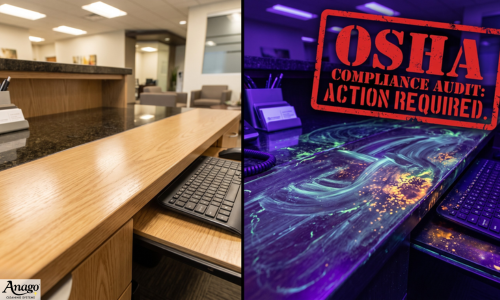
Commercial cleaning compliance requires a continuous, documented risk mitigation strategy rather than intermittent visual touch-ups. Mid-year internal audits frequently uncover operational gaps between daily maintenance routines and strict regulatory benchmarks set by OSHA and CDC standards.
Establishing verified disinfectant contact times, EPA-registered protocols, and digital audit trails mitigates liability exposure, prevents corrective action plans (CAPs), and protects facility operational continuity. When clean is non-negotiable, facility leaders must treat environmental sanitation as a core governance metric.
Surprise regulatory inspections fail facilities not because of visible surface clutter, but due to unverifiable sanitation documentation and non-compliant disinfectant dwell times. Relying on visual inspection creates a false sense of security, exposing commercial properties to regulatory fines, forced operational pauses, and corrective action plans (CAPs).
Facility managers often operate under the assumption that if a building looks clean, it will pass an inspection. This assumption represents a critical operational vulnerability. Regulatory bodies such as OSHA and healthcare inspectors evaluate verifiable microbiological control, chemical safety data sheets (SDS), and chain-of-custody execution.
Key Insight: Rapid, frequent wiping down of high-traffic surfaces often increases microbial contamination instead of reducing it. When staff quickly wipe a surface without allowing the full chemical dwell time listed on EPA-registered disinfectants, they fail to neutralize pathogens and spread active bio-burden across adjacent surfaces.
When a surprise inspection occurs, inspectors immediately request historical verification logs. If your service providers cannot produce timestamped proof of protocol execution, your facility is instantly flagged for non-compliance.
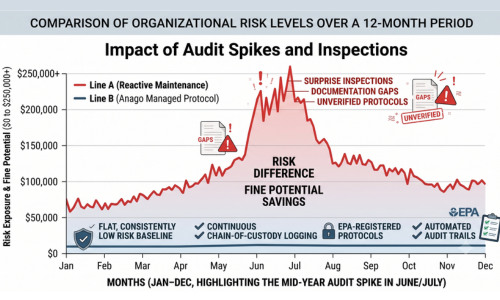
Transitioning to ongoing audit readiness requires replacing informal daily tasks with standardized, EPA-registered disinfection protocols and digital verification logs.
Commercial cleaning service providers implement systematic risk mitigation schedules, ensuring that every touchpoint meets strict healthcare benchmarks and CDC standards every single day, eliminating mid-year inspection panic.
To transition your facility from a reactive posture to permanent audit readiness, execute this four-step mid-year reset framework:
Standard maintenance focuses on surface aesthetics and basic trash removal, leaving hidden pathogens and liability gaps unaddressed. In contrast, compliance-level facility risk mitigation utilizes certified HEPA filtration, targeted pathogen control, and SCOF floor safety benchmarks to systematically satisfy OSHA regulations and mitigate long-term premises liability.
| Operational Dimension | Standard Commercial Maintenance | Anago Facility Risk Mitigation |
| Primary Goal | Visual tidiness & surface dust removal | Regulatory compliance & asset protection |
| Disinfection Standards | Generic cleaning agents applied without dwell-time tracking | EPA-registered list disinfectants with strict dwell-time protocols |
| Air Quality Protocols | Standard vacuuming (re-circulates particulates) | Certified HEPA filtration units capturing 99.97% of airborne micro-particulates |
| Verification & Logging | Manual paper checklists (often signed in bulk post-shift) | Digital chain-of-custody tracking with timestamped reporting |
| Floor Safety Benchmarks | Standard mopping with variable slip coefficients | SCOF standard compliance targeting ANSI/NFSI high-traction thresholds |
| Regulatory Alignment | None / Reactive upon receiving citations | Proactive alignment with OSHA, CDC standards, and local health mandates |
Unverified facility maintenance exposes organizations to legal liabilities, employee illness claims, and regulatory sanctions. By maintaining chain-of-custody logging and standardized surface testing, facility managers convert routine environmental maintenance into defensible legal proof of compliance, safeguarding organizational reputation and operational budgets during surprise inspections.
[Standardization across sites] ➔ [Verified EPA-Registered Protocols] ➔ [Digital Audit Trail] ➔ [Zero Compliance Citations]
When an incident occurs (whether an outbreak of workplace illness or an slip-and-fall claim), the burden of proof lies on the facility leadership.
By partnering with professional Facility Service Partners such as Anago, enterprise managers can meet every regulation without missing a beat, ensuring professional service that passes inspection every time.
Securing executive budget and buy-in for compliance-level facility services requires framing the investment around risk avoidance, financial liability reduction, and brand protection. Use these tailored arguments for your internal buying committee:
For the Director of Finance (CFO)
“Transitioning to a verified facility service model shifts our exposure from unpredictable, high-cost liabilities (such as OSHA non-compliance penalties averaging $16,131 per serious violation in projected 2026 enforcement scales, or slip-and-fall litigation) into a predictable, fixed operational expense. Compliance-level maintenance functions as an insurance policy for our real estate portfolio.”
For the EH&S and Compliance Officer
“We are replacing subjective visual checks with verifiable, audit-ready documentation. By integrating EPA-registered protocols and automated logging, we guarantee that our facilities align with CDC standards and OSHA workplace safety mandates, eliminating audit panic during mid-year reviews.”
For the Operations Director / Legal Counsel
“Inconsistent vendor execution across locations creates legal exposure. Partnering with a unified Facility Service Partner standardizes our operational governance, protects our brand equity, and provides documented chain-of-custody evidence to defend against premises liability claims.”
Don't wait for a regulatory citation to discover gaps in your environmental sanitation protocols. Protect your facility, your occupants, and your operational budget with a verified risk-mitigation strategy.
Book a Technical Scoping Call with an Anago Compliance Specialist today to audit your current protocols and establish verifiable standards across all properties.
By Darlene Bernd, Content Marketing Manager