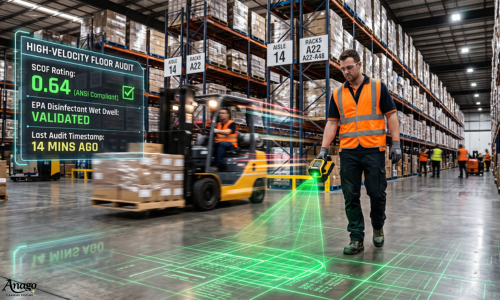
High-foot-traffic industrial, manufacturing, and logistics hubs must replace manual janitorial logs with data-driven cleaning programs to satisfy OSHA safety regulations, SQF/GMP audit standards, and operational risk guidelines. Integrating automated quality assurance applications and cloud-based portals transforms floor safety, particulate control, and sanitation tasks into verifiable, timestamped data streams. When clean is non-negotiable, leveraging technical commercial cleaning KPIs mitigates slip-and-fall hazards, protects high-value inventory assets, and keeps supply chains moving without regulatory interruption.
How can technology-enabled commercial cleaning systems guarantee audit readiness?
Cloud-based communication portals and automated quality assurance apps turn qualitative sanitation performance into verifiable, transparent data streams that pass strict regulatory audits.
Manual janitorial sheets fail to satisfy modern industrial audits because they lack timestamped proof, chemical dwell-time verification, and actionable friction safety logs. Technology-enabled cleaning management replaces paper tracking with real-time digital auditing, ensuring plant managers meet every regulation without missing a beat.
In high-velocity distribution centers, manufacturing plants, and logistics parks, heavy machinery, forklift traffic, and shift work create rapid environmental wear. Airborne particulates settle on overhead structures, oil micro-droplets compromise walkways, and high-touch areas in operator hubs quickly become vectors for cross-contamination. Relying on paper checklists clipped to warehouse posts offers zero verifiable protection when an OSHA inspector or third-party quality auditor arrives on-site.
Many industrial operations managers believe that running automated ride-on floor scrubbers on a continuous loop guarantees walkway safety and clean air compliance. This is a dangerous operational misconception.
Continuous wet-scrubbing without regular measurement of Static Coefficient of Friction (SCOF) often creates a false sense of security while actually increasing slip-and-fall liabilities. Incorrect detergent dilution ratios leave slippery chemical films on polished concrete, while unmonitored squeegee blades streak water across high-traffic pedestrian zones. Furthermore, floor-level cleaning fails to address combustible dust accumulating on overhead joists and air ducts.
To mitigate operational risk and protect physical assets, facility service partners must transition from blind floor coverage to technical, data-verified execution. Measuring precise friction standards and tracking airborne particulate capture ensures facilities remain audit-ready and fully operational.
Industrial facilities must monitor specialized facility cleaning metrics to reduce occupational hazards, protect sensitive machinery, and prevent audit failure. Essential KPIs include walkway Static Coefficient of Friction (SCOF) values, HEPA air filtration efficiency, rapid spill response times, and high-touch surface sanitation compliance.
Establishing robust quality assurance systems requires tracking both safety-focused and operational efficiency metrics. The following table outlines the technical metrics required to align facility maintenance with rigorous industrial standards:
| Metric / KPI | Technical Definition | Target Benchmark | Regulatory / Entity Alignment | Operational Impact |
| Walkway SCOF Rating | Static Coefficient of Friction measured on active transit aisles and loading docks. | ≥ 0.60 SCOF | ANSI/B101.1 / SCOF Standards / OSHA | Directly mitigates slip, trip, and fall injuries in high-traffic zones. |
| Overhead Particulate & HEPA Load | Air quality differential and dust accumulation depth on high structures. | < 1/32 inch (HEPA Validated) | OSHA 1910.22 / NFPA Combustible Dust | Eliminates fire hazards, prevents product contamination, and improves IAQ. |
| Chemical Contact & Dwell Time | Percentage of surface disinfections meeting required wet dwell times. | ≥ 99.0% | EPA-registered Disinfectants / SQF / GMP | Validates micro-organism neutralization in processing and break areas. |
| Hazardous Spill Response Time | Elapsed time from automated incident logging to verified hazard containment. | < 15 Minutes | OSHA Hazard Communication Standards | Accelerates line recovery and minimizes operational downtime. |
| QA Portal Audit Compliance Score | Aggregate score derived from mobile inspections across facility zones. | ≥ 95.0% | ISO 9001 / Internal EHS Benchmarks | Provides verifiable, audit-ready data for corporate safety committee reviews. |
Establishing these concrete indicators transforms daily sanitation routines into measurable risk management assets across industrial footprints.
Automated quality assurance applications deploy location-based tracking, digital inspection forms, and cloud reporting across vast warehouse square footage. By mapping high-volume zones, these clean-tech systems convert routine cleaning tasks into immutable, audit-ready compliance streams.
Executing consistent facility cleaning across multi-million-square-foot logistics networks requires a structured, technology-driven workflow:
Across multi-site distribution networks, logistics centers utilizing mobile QA portals achieved a 38% reduction in OSHA-recordable slip-and-fall incidents within 90 days of implementation.
Securing executive buy-in across an industrial buying committee requires connecting data-driven facility service to core business objectives: throughput, risk reduction, regulatory compliance, and cost control. Tailoring the messaging to each internal champion streamlines executive approval.
| Leadership Role | Core Priority | Key Messaging Angle |
| VP of Operations / Plant Manager | Downtime Minimization & Throughput | Frame the technology as an operational protection tool. Explain how rapid spill response times and automated QA workflows prevent unexpected production line halts and maintain facility velocity. |
| EH&S Director / Safety Manager | OSHA Compliance & Loss Control | Focus on hazard prevention and regulatory defense. Highlight how continuous ANSI-aligned SCOF friction logging and HEPA overhead dust tracking build an immutable legal defense against citations and injury claims. |
| Quality Assurance & SQF Manager | Product Safety & Audit Readiness | Emphasize process repeatability and cross-contamination control. Demonstrate how cloud portals track EPA-registered disinfectant contact times to guarantee compliance with strict SQF and GMP standards. |
| Chief Financial Officer / Risk Director | Insurance Premiums & Liability Management | Position the program as a risk mitigation asset. Show how verifiable floor safety data lowers worker compensation claims, protects expensive equipment assets, and stabilizes facility OpEx. |
Mitigating industrial risk, protecting worker safety, and guaranteeing audit readiness demands an enterprise-grade facility service partner.
Book a Technical Scoping Call to evaluate your plant's operational baseline and deploy an audit-ready facility management strategy.
By Darlene Bernd, Content Marketing Manager